
We are in Kansas, Toto. It's the Wakarusa music and camping festival set in beautiful Lawrence, Kansas. We've got a crack team of biodiesel advocates: Allison, Nash, and three new friends, Theresa, Suzy and Kenny. The weather is fine and the festival folk are friendly, although we've had a couple stumblers walk up. One girl looked at the biodiesel samples and thought we were selling apple juice. Another late-nighter walked up to Allison and said, "Will it make me go 'vroom?'” Wobble, wobble, wobble. “Will you go 'vroom' with me?"
Tomorrow, we'll do some hands-on demonstrations and make some biodiesel batches with the leftover grease from the vendor tents selling curly fries and coney dogs and funnel cakes. Mmmmm. There will definitely be photos to follow.
Friday, June 8, 2007

Lovin' Lovins
One of my newest heroes plays with Orangutans. In addition to being an advocate for 'higher primates,' Amory Lovins is one of the foremost energy experts and renewable energy advocates in the country -- he's written several visionary books and founded the Rocky Mountain Institute, which I recommend everyone have a look at online. There are some amazing things happening at this place.
Lovins house near Carbondale, Colorado is also an amazing example of the possible. I just parked the 'trekker there for a few days to visit my latest business partner and 'brother in bio' Nash Evans, who is the in-house contractor at RMI. The house is 4,000 square feet and has an average utility bill of $5 a month. It's an earth bermed building with an indoor greenhouse that acts as a passive solar heater. It also has several enormous solar PV arrays, and solar thermal hot water heating. There's an indoor stream and koi pond (with turtle!) a hot tub, an enormous energy efficient fridge, etc. Basically, it's the kind of house I've been building in my mind for several years now. It's also got a 500-year life span. I did get some photos, which I'll be posting soon, but the house is being remodeled, so it doesn't look quite as beautiful as it will in a year.
Lovins' residence also serves as an office for RMI employees, and will soon re-open to the public for tours. It's a huge inspiration, and I'd recommend it (and all of Lovins' work) to anyone who is looking for an example of uplifiting human progress.
Lovins house near Carbondale, Colorado is also an amazing example of the possible. I just parked the 'trekker there for a few days to visit my latest business partner and 'brother in bio' Nash Evans, who is the in-house contractor at RMI. The house is 4,000 square feet and has an average utility bill of $5 a month. It's an earth bermed building with an indoor greenhouse that acts as a passive solar heater. It also has several enormous solar PV arrays, and solar thermal hot water heating. There's an indoor stream and koi pond (with turtle!) a hot tub, an enormous energy efficient fridge, etc. Basically, it's the kind of house I've been building in my mind for several years now. It's also got a 500-year life span. I did get some photos, which I'll be posting soon, but the house is being remodeled, so it doesn't look quite as beautiful as it will in a year.
Lovins' residence also serves as an office for RMI employees, and will soon re-open to the public for tours. It's a huge inspiration, and I'd recommend it (and all of Lovins' work) to anyone who is looking for an example of uplifiting human progress.
Friday, May 25, 2007
If We Have to Hear About Hilton

I don’t seek celebrity news and gossip, and I avoid most traditional news outlets, but I can’t avoid knowing about the latest saga of Paris Hilton. It could be infuriating if it weren’t so amazing. Maybe she’s really got the heart of Mother Theresa, or maybe she’s the antichrist in Gucci. I don’t know, and — until the day that Paris Hilton rescues my grandmother from drowning or is elected head-of-state, forms an army and organizes mass genocide — I don’t care.
Still, this celebrity stuff has a way of finding us all. Even if you politely ask the clowns to leave, the mainstream circus sets up the big top right outside your door and parades the screaming chimps along your porch rails until you pay attention. Somewhere, on an island off the coast of Indonesia, there’s a man in a loincloth eating roasted insects who knows that Britney Spears shaved her head.
Like Arnold the Governator, I also feel that I have “more important things to do,” than to closely follow the misdemeanors of the rich and famous. Some people think they deserve it, but I feel like it’s bad karma to revel in the low points of someone else’s life. I definitely wouldn’t have wanted press coverage during my early twenties.
But if we have to know about it, here is a very serious suggestion for the entourage of Paris Hilton or those in charge of her legal fate. If the point of her jail sentence is to make her feel like someone who doesn’t have millions of dollars in a bank account, it won’t be effective. Until the day that Paris Hilton is magically transformed into a poverty-stricken racial minority or someone born to a homeless mother or someone sexually abused by foster parents, she’ll never know how it feels to live like “the other half.”
Instead of trying to erase her fame and fortune with a 45-day jail sentence, why not put it to good use for a cause that serves her community and the world? Here is a recommendation for alternative sentencing that would do just that: Require Ms. Hilton to become a spokesperson for environmental building practices, greenhouse gas reduction and clean, renewable energy for one year. Just imagine the world stage you could create for spreading awareness of these serious issues.
First, Ms. Hilton could do this by spending her money to build a zero-energy hotel and conference center, featuring green building materials and the latest solar technology for heating and cooling. You could require that she organize renewable energy rallies to help pay for the project and mandate that a percentage of the profits return to the community. Second, she could be required to use only biofueled transportation. In fact, once she does return to driving, I know someone who can set her up a Porsche to run on 100 percent ethanol. But then she’d probably have to fund an ethanol station in Hollywood to fuel it.
There are some celebrities out there, like Darryl Hannah, who have chosen to focus their limelight in a way that also serves others. Rather than spanking those who don’t by trying to make them feel poor, doesn’t it make more sense to help them direct their considerable resources and popularity in positive ways? Rather than wishing the mainstream media outlets would give more attention to critical world issues and less to celebrity hairstyles, why not commandeer one of their favorite targets and do it for them?
Thursday, May 3, 2007
April Absence

I know. I missed April entirely on the blog. No quotes from street walkers. No men in panties and cowboy boots. No close calls with semis. I'll do better in the future, I promise. In fact, soon I'll regale you with the dumbest maneuver a man has ever pulled in a motorhome. If you like narrowly averted disasters, you'll love this.
For the next month, I'll be catching up in my home base of Portland, Oregon. Doing some writing, waterfall hiking and overall maintenance before leaving on a summer concert tour in June. Anyone going from Portland to the Sasquatch Festival, the Wakarusa Festival near Kansas City or the Bonnaroo Festival in Tennessee, let me know. Rides are available.
Check out the updated Links section on the website, or if you're in the mood to advertise, check out the latest ebay auction by clicking here. Biodiesel doesn't pay for itself you know.
Wednesday, March 21, 2007
Midwest Madness
Wisconsin has been great for the last week -- full of cold, sunny weather and a lot of new friends. It's a beautiful, bucholic country up this way. Red barns, big silos and rolling pastures around every bend. It makes me want to eat cheese. The kids at Webster Elementary were amazing and we had fun singing the new "Biodiesel, It's My Fuel" song I've been working on. Look for it on MTV very soon.
Allison toured me around the area and I got to meet some of the family, including Mugga, who is not a fan of French Onion Dip. I also witnessed the untimely end of an opossum at the paws of Major, talked about the A-team with Dell, leafed through old photos with Dave and Diane, talked fishun' with Flip the Jazz Man and walked the lake with an Original Princess (it sounds much better than the Big Princess). My thanks to everyone for the hospitality.
On Monday, March 26 I'm stoked to attend the groundbreaking of Wisconsin's largest biodiesel plant in Evansville. It's a cooperative project coordinated by the crew of North Prarie Productions LLC. Talk about empowered and enterprising individuals.
The next day, I'll begin heading west, moving at a little faster pace. I'm looking forward to seeing my Montana clan and then moving on to do some solar thermal advocacy in California before setting the wheels down in Portland for a while. Early summer in Oregon is not to be missed.
Allison toured me around the area and I got to meet some of the family, including Mugga, who is not a fan of French Onion Dip. I also witnessed the untimely end of an opossum at the paws of Major, talked about the A-team with Dell, leafed through old photos with Dave and Diane, talked fishun' with Flip the Jazz Man and walked the lake with an Original Princess (it sounds much better than the Big Princess). My thanks to everyone for the hospitality.
On Monday, March 26 I'm stoked to attend the groundbreaking of Wisconsin's largest biodiesel plant in Evansville. It's a cooperative project coordinated by the crew of North Prarie Productions LLC. Talk about empowered and enterprising individuals.
The next day, I'll begin heading west, moving at a little faster pace. I'm looking forward to seeing my Montana clan and then moving on to do some solar thermal advocacy in California before setting the wheels down in Portland for a while. Early summer in Oregon is not to be missed.
Monday, March 5, 2007
Brain Still One Month Behind Body
 It's true, the adventures are happening faster than I can write them down. I'm okay with that now. I've made my peace. Hopefully, you will too. Real-time is overrated anyway. I mean, how can you possibly fault me when I'm in the company of folks like Leslie, the Mayor of Mardi Gras? Have a look at other fun and well-shot photographs by my new friend and fellow freelancer Benjamin Arseguel, at www.flickr.com/photos/propelfilms
I had to forego Florida because it felt like too much of a rush. So I'm still in Austin for another week. That's when I'll head north where spring will have fully arrived, melted all snow and banished cold temperatures. I'll have your weekend forecasts later on tonight.
Tuesday, February 20, 2007
Asking For Adventure
After the month I’ve had, I’m seriously considering a name change. I asked for adventures and I’m getting adventures, but maybe I should have been more specific. Maybe I should have gone with, “Tranquil Adventures in Biodiesel,” or “Occasionally Eventful Adventures in Biodiesel,” or “Zen Adventures in Biodiesel.”
And while I’m at it, it might be a good idea to cut out that part on the homepage about sprinkling in a “little insanity.” It think I left the lid loose on the jar, and the sprinkle turned into a full-on pour, because after leaving Northern California and the calm of the redwoods, the stew of my life has been heavily spiced with my own insanity.
 The sky was clear when I left Crescent City and headed for Highway 199 on Tuesday morning, January 16. I’d spent the night in a vacant gravel parking lot next to a ranger station near Tolowa Dunes State Park. I didn’t realize I was doing anything I could be busted for, but it’s hard to be familiar with all the bustable offenses in every new area, so you just do your thing, secure in the knowledge that if you are doing something bustable, a buster will show up and inform you that you’ve been busted. That’s what happened in the morning, when a ranger knocked on my door and told me that he’d caught me spending the night in the lot. It was keen detective work, and I wanted to ask him how he knew that this big orange and yellow bus with green liquid flames was the same one he’d seen the night before, but busters can be sensitive. So I smiled, knowing he was just doing his job, and told him the truth: I wasn’t aware of the law he was now telling me about, that RVs are required to park in private lots.
“If we let people park wherever they wanted, there would be motorhomes filling up every spot in the summer,” the buster said.
I looked out over the huge vacant lot and he followed my gaze. “Well, even in the winter there can be a lot of visitors,” he said. “I’ll let you go with a warning this morning, but your plates are in the system. Just make sure that you park in a campground from now on.”
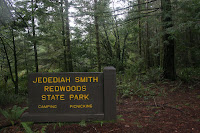 Now a registered offender, I made my way to Jedediah State Redwoods Park. It began to rain, a drizzle first, which became fat, high-speed drops. Shaking the moisture off after a bike ride, I climbed in the RV and set out for the Oregon border. For about ten miles, it was a peaceful drive, set in the stunning scenery of the Smith River Canyon, with impossibly-colored turquoise water gliding flat in the channels and churning white in the rocky spots.

White turned out to be the theme for the day. It started with the water. But then white began coming from the sky, made its way to my knuckles and eventually reached my face. The snow hit hard after just a few miles, and by the time I was climbing the steepest grades in a 34-foot bus, the trees, the road and the shoulder were all covered in about five inches of fresh stuff. The snowplows weren’t out yet, so the best thing to do was stay in the tracks. Turning around wasn’t an option in a big rig; none of the side roads or turnouts even had tracks. And pulling off to the side to wait it out was sketchy. What if the freak blizzard lasted for a week?
Drawing on experience from years of driving in Montana winters, I cut the speed to about 10 mph and loped up the hills and around the sharp turns. The way up was tense, but solid. It wasn’t until the descent into Oregon that the rear wheels started slipping. I’d never experienced fishtails in a 30,000-pound vehicle and I hope I never have a repeat. It felt like trying to steer a taboggan. Finally, after an inch-at-a-time downward zig-zag next to sheer canyon walls and riverside cliffs, we reached the valley floor and the snow started to thin out. It was slushy and asphalt was showing, and I decided it was okay to pry my fingernails out of the steering wheel. Things were bound to be much easier at this lower elevation.
Things were easier for about thirty miles. And then, just outside of Cave Junction, Oregon, the patches of asphalt disappeared and the slush turned to ice. A line of cars formed behind me and stretched out in front and our entire procession slowed to walking speed. We slowly passed several vehicles sitting in the ditch at various angles on both sides of the road. My fingernails found their way back to the dents still in the steering wheel, and my heart resumed it’s double-time polka pace.
I was lucky enough to find myself directly behind a loaded semi with balding tires. I was doing my best to keep off the brakes, using the engine to slow down, but that became impossible when the semi driver lost control of his trailer. The box began to slide sideways, and the front of the rig slid toward the ditch. My heart slid into my stomach, and I put on the brakes. Now the back of my coach began to slide toward the ditch. It was a slow glide to th e shoulder, and I thought something like, “Well, it’s been a fun few months, but it’s all about to come to an end when I roll into this ditch.”
But the snow on the shoulder was thick and sticky enough to hold, and I came to a stop behind the semi. I never imagined it would be so nice to have a change of pants on hand. The dry britches helped, though, and I stepped out on the ice to see if I could help the truck driver with his chains. About an hour later, we were ready to start the slow roll again. Eventually, the snow thinned again, and I reached Grants Pass and I-5 just in time to line up behind hundreds of cars waiting for the truck drivers to take off their chains now that the snow was slush again.
The going was slow for most of the trip, but I reached Eugene at around seven that night, with the entire state of Oregon still in deep freeze. It’s funny how a leisurely four-hour drive can turn into an icy, eight-hour tango with near catastrophe. It’s also funny how you sometimes get exactly what you ask for. I was hoping that this bioTrekker journey would bring adventures, but I’d also been feeling the desire to slow down a bit. The trip back from California was definitely adventurous, and I was forced to slow down. Although I didn’t know it at the time, it was a pattern that would be playing out for a few more weeks.
And while I’m at it, it might be a good idea to cut out that part on the homepage about sprinkling in a “little insanity.” It think I left the lid loose on the jar, and the sprinkle turned into a full-on pour, because after leaving Northern California and the calm of the redwoods, the stew of my life has been heavily spiced with my own insanity.
 The sky was clear when I left Crescent City and headed for Highway 199 on Tuesday morning, January 16. I’d spent the night in a vacant gravel parking lot next to a ranger station near Tolowa Dunes State Park. I didn’t realize I was doing anything I could be busted for, but it’s hard to be familiar with all the bustable offenses in every new area, so you just do your thing, secure in the knowledge that if you are doing something bustable, a buster will show up and inform you that you’ve been busted. That’s what happened in the morning, when a ranger knocked on my door and told me that he’d caught me spending the night in the lot. It was keen detective work, and I wanted to ask him how he knew that this big orange and yellow bus with green liquid flames was the same one he’d seen the night before, but busters can be sensitive. So I smiled, knowing he was just doing his job, and told him the truth: I wasn’t aware of the law he was now telling me about, that RVs are required to park in private lots.
“If we let people park wherever they wanted, there would be motorhomes filling up every spot in the summer,” the buster said.
I looked out over the huge vacant lot and he followed my gaze. “Well, even in the winter there can be a lot of visitors,” he said. “I’ll let you go with a warning this morning, but your plates are in the system. Just make sure that you park in a campground from now on.”
 Now a registered offender, I made my way to Jedediah State Redwoods Park. It began to rain, a drizzle first, which became fat, high-speed drops. Shaking the moisture off after a bike ride, I climbed in the RV and set out for the Oregon border. For about ten miles, it was a peaceful drive, set in the stunning scenery of the Smith River Canyon, with impossibly-colored turquoise water gliding flat in the channels and churning white in the rocky spots.
White turned out to be the theme for the day. It started with the water. But then white began coming from the sky, made its way to my knuckles and eventually reached my face. The snow hit hard after just a few miles, and by the time I was climbing the steepest grades in a 34-foot bus, the trees, the road and the shoulder were all covered in about five inches of fresh stuff. The snowplows weren’t out yet, so the best thing to do was stay in the tracks. Turning around wasn’t an option in a big rig; none of the side roads or turnouts even had tracks. And pulling off to the side to wait it out was sketchy. What if the freak blizzard lasted for a week?
Drawing on experience from years of driving in Montana winters, I cut the speed to about 10 mph and loped up the hills and around the sharp turns. The way up was tense, but solid. It wasn’t until the descent into Oregon that the rear wheels started slipping. I’d never experienced fishtails in a 30,000-pound vehicle and I hope I never have a repeat. It felt like trying to steer a taboggan. Finally, after an inch-at-a-time downward zig-zag next to sheer canyon walls and riverside cliffs, we reached the valley floor and the snow started to thin out. It was slushy and asphalt was showing, and I decided it was okay to pry my fingernails out of the steering wheel. Things were bound to be much easier at this lower elevation.
Things were easier for about thirty miles. And then, just outside of Cave Junction, Oregon, the patches of asphalt disappeared and the slush turned to ice. A line of cars formed behind me and stretched out in front and our entire procession slowed to walking speed. We slowly passed several vehicles sitting in the ditch at various angles on both sides of the road. My fingernails found their way back to the dents still in the steering wheel, and my heart resumed it’s double-time polka pace.
I was lucky enough to find myself directly behind a loaded semi with balding tires. I was doing my best to keep off the brakes, using the engine to slow down, but that became impossible when the semi driver lost control of his trailer. The box began to slide sideways, and the front of the rig slid toward the ditch. My heart slid into my stomach, and I put on the brakes. Now the back of my coach began to slide toward the ditch. It was a slow glide to th
 e shoulder, and I thought something like, “Well, it’s been a fun few months, but it’s all about to come to an end when I roll into this ditch.”
But the snow on the shoulder was thick and sticky enough to hold, and I came to a stop behind the semi. I never imagined it would be so nice to have a change of pants on hand. The dry britches helped, though, and I stepped out on the ice to see if I could help the truck driver with his chains. About an hour later, we were ready to start the slow roll again. Eventually, the snow thinned again, and I reached Grants Pass and I-5 just in time to line up behind hundreds of cars waiting for the truck drivers to take off their chains now that the snow was slush again.
The going was slow for most of the trip, but I reached Eugene at around seven that night, with the entire state of Oregon still in deep freeze. It’s funny how a leisurely four-hour drive can turn into an icy, eight-hour tango with near catastrophe. It’s also funny how you sometimes get exactly what you ask for. I was hoping that this bioTrekker journey would bring adventures, but I’d also been feeling the desire to slow down a bit. The trip back from California was definitely adventurous, and I was forced to slow down. Although I didn’t know it at the time, it was a pattern that would be playing out for a few more weeks.
Subscribe to:
Posts (Atom)