
Wisconsin has been great for the last week -- full of cold, sunny weather and a lot of new friends. It's a beautiful, bucholic country up this way. Red barns, big silos and rolling pastures around every bend. It makes me want to eat cheese. The kids at Webster Elementary were amazing and we had fun singing the new "Biodiesel, It's My Fuel" song I've been working on. Look for it on MTV very soon.
Allison toured me around the area and I got to meet some of the family, including Mugga, who is not a fan of French Onion Dip. I also witnessed the untimely end of an opossum at the paws of Major, talked about the A-team with Dell, leafed through old photos with Dave and Diane, talked fishun' with Flip the Jazz Man and walked the lake with an Original Princess (it sounds much better than the Big Princess). My thanks to everyone for the hospitality.
On Monday, March 26 I'm stoked to attend the groundbreaking of Wisconsin's largest biodiesel plant in Evansville. It's a cooperative project coordinated by the crew of North Prarie Productions LLC. Talk about empowered and enterprising individuals.
The next day, I'll begin heading west, moving at a little faster pace. I'm looking forward to seeing my Montana clan and then moving on to do some solar thermal advocacy in California before setting the wheels down in Portland for a while. Early summer in Oregon is not to be missed.
Wednesday, March 21, 2007

Monday, March 5, 2007
Brain Still One Month Behind Body
 It's true, the adventures are happening faster than I can write them down. I'm okay with that now. I've made my peace. Hopefully, you will too. Real-time is overrated anyway. I mean, how can you possibly fault me when I'm in the company of folks like Leslie, the Mayor of Mardi Gras? Have a look at other fun and well-shot photographs by my new friend and fellow freelancer Benjamin Arseguel, at www.flickr.com/photos/propelfilms
I had to forego Florida because it felt like too much of a rush. So I'm still in Austin for another week. That's when I'll head north where spring will have fully arrived, melted all snow and banished cold temperatures. I'll have your weekend forecasts later on tonight.
Tuesday, February 20, 2007
Asking For Adventure
After the month I’ve had, I’m seriously considering a name change. I asked for adventures and I’m getting adventures, but maybe I should have been more specific. Maybe I should have gone with, “Tranquil Adventures in Biodiesel,” or “Occasionally Eventful Adventures in Biodiesel,” or “Zen Adventures in Biodiesel.”
And while I’m at it, it might be a good idea to cut out that part on the homepage about sprinkling in a “little insanity.” It think I left the lid loose on the jar, and the sprinkle turned into a full-on pour, because after leaving Northern California and the calm of the redwoods, the stew of my life has been heavily spiced with my own insanity.
 The sky was clear when I left Crescent City and headed for Highway 199 on Tuesday morning, January 16. I’d spent the night in a vacant gravel parking lot next to a ranger station near Tolowa Dunes State Park. I didn’t realize I was doing anything I could be busted for, but it’s hard to be familiar with all the bustable offenses in every new area, so you just do your thing, secure in the knowledge that if you are doing something bustable, a buster will show up and inform you that you’ve been busted. That’s what happened in the morning, when a ranger knocked on my door and told me that he’d caught me spending the night in the lot. It was keen detective work, and I wanted to ask him how he knew that this big orange and yellow bus with green liquid flames was the same one he’d seen the night before, but busters can be sensitive. So I smiled, knowing he was just doing his job, and told him the truth: I wasn’t aware of the law he was now telling me about, that RVs are required to park in private lots.
“If we let people park wherever they wanted, there would be motorhomes filling up every spot in the summer,” the buster said.
I looked out over the huge vacant lot and he followed my gaze. “Well, even in the winter there can be a lot of visitors,” he said. “I’ll let you go with a warning this morning, but your plates are in the system. Just make sure that you park in a campground from now on.”
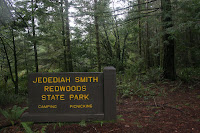 Now a registered offender, I made my way to Jedediah State Redwoods Park. It began to rain, a drizzle first, which became fat, high-speed drops. Shaking the moisture off after a bike ride, I climbed in the RV and set out for the Oregon border. For about ten miles, it was a peaceful drive, set in the stunning scenery of the Smith River Canyon, with impossibly-colored turquoise water gliding flat in the channels and churning white in the rocky spots.

White turned out to be the theme for the day. It started with the water. But then white began coming from the sky, made its way to my knuckles and eventually reached my face. The snow hit hard after just a few miles, and by the time I was climbing the steepest grades in a 34-foot bus, the trees, the road and the shoulder were all covered in about five inches of fresh stuff. The snowplows weren’t out yet, so the best thing to do was stay in the tracks. Turning around wasn’t an option in a big rig; none of the side roads or turnouts even had tracks. And pulling off to the side to wait it out was sketchy. What if the freak blizzard lasted for a week?
Drawing on experience from years of driving in Montana winters, I cut the speed to about 10 mph and loped up the hills and around the sharp turns. The way up was tense, but solid. It wasn’t until the descent into Oregon that the rear wheels started slipping. I’d never experienced fishtails in a 30,000-pound vehicle and I hope I never have a repeat. It felt like trying to steer a taboggan. Finally, after an inch-at-a-time downward zig-zag next to sheer canyon walls and riverside cliffs, we reached the valley floor and the snow started to thin out. It was slushy and asphalt was showing, and I decided it was okay to pry my fingernails out of the steering wheel. Things were bound to be much easier at this lower elevation.
Things were easier for about thirty miles. And then, just outside of Cave Junction, Oregon, the patches of asphalt disappeared and the slush turned to ice. A line of cars formed behind me and stretched out in front and our entire procession slowed to walking speed. We slowly passed several vehicles sitting in the ditch at various angles on both sides of the road. My fingernails found their way back to the dents still in the steering wheel, and my heart resumed it’s double-time polka pace.
I was lucky enough to find myself directly behind a loaded semi with balding tires. I was doing my best to keep off the brakes, using the engine to slow down, but that became impossible when the semi driver lost control of his trailer. The box began to slide sideways, and the front of the rig slid toward the ditch. My heart slid into my stomach, and I put on the brakes. Now the back of my coach began to slide toward the ditch. It was a slow glide to th e shoulder, and I thought something like, “Well, it’s been a fun few months, but it’s all about to come to an end when I roll into this ditch.”
But the snow on the shoulder was thick and sticky enough to hold, and I came to a stop behind the semi. I never imagined it would be so nice to have a change of pants on hand. The dry britches helped, though, and I stepped out on the ice to see if I could help the truck driver with his chains. About an hour later, we were ready to start the slow roll again. Eventually, the snow thinned again, and I reached Grants Pass and I-5 just in time to line up behind hundreds of cars waiting for the truck drivers to take off their chains now that the snow was slush again.
The going was slow for most of the trip, but I reached Eugene at around seven that night, with the entire state of Oregon still in deep freeze. It’s funny how a leisurely four-hour drive can turn into an icy, eight-hour tango with near catastrophe. It’s also funny how you sometimes get exactly what you ask for. I was hoping that this bioTrekker journey would bring adventures, but I’d also been feeling the desire to slow down a bit. The trip back from California was definitely adventurous, and I was forced to slow down. Although I didn’t know it at the time, it was a pattern that would be playing out for a few more weeks.
And while I’m at it, it might be a good idea to cut out that part on the homepage about sprinkling in a “little insanity.” It think I left the lid loose on the jar, and the sprinkle turned into a full-on pour, because after leaving Northern California and the calm of the redwoods, the stew of my life has been heavily spiced with my own insanity.
 The sky was clear when I left Crescent City and headed for Highway 199 on Tuesday morning, January 16. I’d spent the night in a vacant gravel parking lot next to a ranger station near Tolowa Dunes State Park. I didn’t realize I was doing anything I could be busted for, but it’s hard to be familiar with all the bustable offenses in every new area, so you just do your thing, secure in the knowledge that if you are doing something bustable, a buster will show up and inform you that you’ve been busted. That’s what happened in the morning, when a ranger knocked on my door and told me that he’d caught me spending the night in the lot. It was keen detective work, and I wanted to ask him how he knew that this big orange and yellow bus with green liquid flames was the same one he’d seen the night before, but busters can be sensitive. So I smiled, knowing he was just doing his job, and told him the truth: I wasn’t aware of the law he was now telling me about, that RVs are required to park in private lots.
“If we let people park wherever they wanted, there would be motorhomes filling up every spot in the summer,” the buster said.
I looked out over the huge vacant lot and he followed my gaze. “Well, even in the winter there can be a lot of visitors,” he said. “I’ll let you go with a warning this morning, but your plates are in the system. Just make sure that you park in a campground from now on.”
 Now a registered offender, I made my way to Jedediah State Redwoods Park. It began to rain, a drizzle first, which became fat, high-speed drops. Shaking the moisture off after a bike ride, I climbed in the RV and set out for the Oregon border. For about ten miles, it was a peaceful drive, set in the stunning scenery of the Smith River Canyon, with impossibly-colored turquoise water gliding flat in the channels and churning white in the rocky spots.
White turned out to be the theme for the day. It started with the water. But then white began coming from the sky, made its way to my knuckles and eventually reached my face. The snow hit hard after just a few miles, and by the time I was climbing the steepest grades in a 34-foot bus, the trees, the road and the shoulder were all covered in about five inches of fresh stuff. The snowplows weren’t out yet, so the best thing to do was stay in the tracks. Turning around wasn’t an option in a big rig; none of the side roads or turnouts even had tracks. And pulling off to the side to wait it out was sketchy. What if the freak blizzard lasted for a week?
Drawing on experience from years of driving in Montana winters, I cut the speed to about 10 mph and loped up the hills and around the sharp turns. The way up was tense, but solid. It wasn’t until the descent into Oregon that the rear wheels started slipping. I’d never experienced fishtails in a 30,000-pound vehicle and I hope I never have a repeat. It felt like trying to steer a taboggan. Finally, after an inch-at-a-time downward zig-zag next to sheer canyon walls and riverside cliffs, we reached the valley floor and the snow started to thin out. It was slushy and asphalt was showing, and I decided it was okay to pry my fingernails out of the steering wheel. Things were bound to be much easier at this lower elevation.
Things were easier for about thirty miles. And then, just outside of Cave Junction, Oregon, the patches of asphalt disappeared and the slush turned to ice. A line of cars formed behind me and stretched out in front and our entire procession slowed to walking speed. We slowly passed several vehicles sitting in the ditch at various angles on both sides of the road. My fingernails found their way back to the dents still in the steering wheel, and my heart resumed it’s double-time polka pace.
I was lucky enough to find myself directly behind a loaded semi with balding tires. I was doing my best to keep off the brakes, using the engine to slow down, but that became impossible when the semi driver lost control of his trailer. The box began to slide sideways, and the front of the rig slid toward the ditch. My heart slid into my stomach, and I put on the brakes. Now the back of my coach began to slide toward the ditch. It was a slow glide to th
 e shoulder, and I thought something like, “Well, it’s been a fun few months, but it’s all about to come to an end when I roll into this ditch.”
But the snow on the shoulder was thick and sticky enough to hold, and I came to a stop behind the semi. I never imagined it would be so nice to have a change of pants on hand. The dry britches helped, though, and I stepped out on the ice to see if I could help the truck driver with his chains. About an hour later, we were ready to start the slow roll again. Eventually, the snow thinned again, and I reached Grants Pass and I-5 just in time to line up behind hundreds of cars waiting for the truck drivers to take off their chains now that the snow was slush again.
The going was slow for most of the trip, but I reached Eugene at around seven that night, with the entire state of Oregon still in deep freeze. It’s funny how a leisurely four-hour drive can turn into an icy, eight-hour tango with near catastrophe. It’s also funny how you sometimes get exactly what you ask for. I was hoping that this bioTrekker journey would bring adventures, but I’d also been feeling the desire to slow down a bit. The trip back from California was definitely adventurous, and I was forced to slow down. Although I didn’t know it at the time, it was a pattern that would be playing out for a few more weeks.
Lots of Living, Little Writing
I obviously have some catching up to do. When you’re doing lots of living that doesn’t leave too much room for doing lots of writing, so the next few blog entries will cover all the adventures of the last month. I’m in Austin now, and I’ll be in the area for the next week, but the craziness of California and the trip down was too rich to skip over. So bear with me as I play catch up.
Thursday, January 25, 2007
Redwood Reverie

If you’re ever feeling uninspired or busy-brained, go sit in solitude in an old growth redwood grove. That's kinda tough to do if you’re anywhere but Northern California/Southern Oregon, but it would probably be worth the money to make the trip out, even if you’re from Miami and it’s just for a day.
I set out for the Newton B Drury scenic drive on the ol’ Mongoose this morning, and after some serious quad burn along the patchy paved/graveled coastal road where I was passed by one car and passed one person, I found that the six-mile scenic drive was closed to cars. I couldn’t have scripted it any better to enter my first experience with these enormous trees by flying down an empty two-laner. It’s a good thing there weren’t any cars on the road b
 ecause I kept wobbling over the center line, preoccupied with tilting my head back as far as it would go, my eyes chasing the enormous trunks into the blue sky. I’ve ridden better with a stomach full of moonshine, but I didn’t care. At the bottom of the grade, I pulled over and read a plaque with a Steinbeck quote. It was about how the redwoods make the most irreverent men humble with awe. I had to laugh, because I think these trees might also have the opposite effect on humble folk, turning the most reverent person into a child. Just minutes earlier, I was pedaling with my arms raised, flying past 10, 12, 14-foot trunks, cheering for these beautiful ancients like they were some of the last ones on Earth. Oh … yeah …
I made it to the extravagantly-named Big Tree. You have to give it to the pioneers, they didn’t mess around with any fancy stuff. Putting dimensions on this tree doesn’t do the experience justice, but at 21-feet wide, the trunk takes longer to walk around than some apartments I've called home. And it’s as tall as a football field turned on end. I tried to take Big Tree's photograph from base to tip, but didn’t have a lens with a wide enough angle. And it’s around 1,500 years old, born when King Arthur was fighting the Saxons, the Chinese were constructing the Great Wall, and the tribes of this area were living in the shade of the giants, catching salmon, hunting game and generally doing a better job of managing their environment over thousands of years than the civilizations that replaced them would do in 200.
 I heard laughing as a couple came down the trail, and I realized the Ever Living Trees were having the same effect on them. They were both smiles when they stepped into the clearing. “Is this the bi— . Holy … I guess this is the big tree!” That was from the guy, who must have been in his thirties. Big Tree subtracted twenty years from him too. “THAT is a big tree. No, that’s a biiig tree.”
Nope, he didn’t say “fantastically lofty tower of bark and branch” or “woody fortress of insane proportions.” I guess the simple name fits. After hiking the rhododendron trail and the Cathedral Trees trail, I noticed the second major effect this trees had on me: Calm.
Inner peace.
Outer peace, too. I felt no need to rush or head back to camp. They’d taken their time getting that big, maybe there’s a lesson in that.
So tomorrow, at my own leisurely pace, it’s on to Jedediah State Park to witness more of the glory.

Friday, January 12, 2007
If You’re Parking In San Francisco…
I really hope that San Francisco doesn’t float off into the Pacific, because it’s an amazing city that was kind to the bioTrekker. Well, other than finding parking. The streets were actually wider than most of Portland’s, but a free parking space is a mythical creature there, like trolls or Republicans. There was no way I was going to chance too much city driving in the hills or triangle-shaped intersections, so after a brief stay at a campground across from Candlestick Park (I’m calling it that forever, I don’t care how many companies plaster their logos on it), I headed back to the East Bay to enjoy a wide asphalt swath in front of a local “mom and pop” general goods store by the name of Target. The Targets weren’t around (it’s pronounced Tarshay, I think they’re French), but the store manager informed me that, yes, as long as it was only for a night or two, I was welcome to bask in the sunshine on their paved paradise. So after a few nights there, I scooted over to a space next to a vacant corner lot in Berkeley. Sure, the lot was fenced and topped with enough razor wire to ward off a legion of Trojan footsoldiers, but maybe the property owner had buried some gold ingots in there. My only concern was that the resident street artists who had done such a lovely job on the buildings would whip up a free “Biodizzle My Nizzle” mural on the outside of the coach. I like to be able to pay for that sort of thing.

There is a place to park oversized vehicles on the Embarcadero, but it’s $30 a day … for pavement. No hookups. No sewer station. No affable Chinese manager who tells you that the best restaurant nearby is called the Clam Shack. But for the last night, I splurged and parked my tourist attraction on Pier 30, right in the shadow of the Bay Bridge. It was almost worth it, just for the view. I never imagined I’d find parking in downtown San Francisco on a pier, three feet from the bay, although at one point, a tugboat was heading straight for me. I thought maybe I’d be torpedoed or asked to move, but instead, the tugboat docked next to a van. A guy got off the tugboat, gave a package to the guy in the van, got back on the tugboat and tugboated off. I would’ve taken a picture, but I was afraid that I might have just witnessed a Russian Mafia weapons exchange.

There is a place to park oversized vehicles on the Embarcadero, but it’s $30 a day … for pavement. No hookups. No sewer station. No affable Chinese manager who tells you that the best restaurant nearby is called the Clam Shack. But for the last night, I splurged and parked my tourist attraction on Pier 30, right in the shadow of the Bay Bridge. It was almost worth it, just for the view. I never imagined I’d find parking in downtown San Francisco on a pier, three feet from the bay, although at one point, a tugboat was heading straight for me. I thought maybe I’d be torpedoed or asked to move, but instead, the tugboat docked next to a van. A guy got off the tugboat, gave a package to the guy in the van, got back on the tugboat and tugboated off. I would’ve taken a picture, but I was afraid that I might have just witnessed a Russian Mafia weapons exchange.
Algae Scientists Cage Match

Yesterday was my last day in San Francisco, and I spent it well. Hiked to the top of Buena Vista Park with some friends and got a little random mandolin serenade from a guy on a park bench. Then, for evening entertainment, I went to learn about algae at a very cool community media center on Valencia Street. Like a lot of biodiesel enthusiasts, I’ve heard about algae’s potential as a feedstock. If it lives up to its promise, algae could possibly do for biodiesel what seed crops can’t: lift it to a place where it could replace consumption of petroleum diesel. But that day is not today, and I’ve been jonesing to hear more about this from someone who has actually worked with the stuff. In other words, a real, live scienteest. Like manna from heaven, that scienteest was delivered in the form of Jonathan Meuser, a graduate student at the University of Colorado School of Mines in Golden, Colorado.
I’ll write a lot more about everything we learned from John in a more formal capacity on the biotrekker site, but for now, I’d just like to give some fun general impressions. When I first learned about the whole algae thing, I had to chuckle. I imagined thin, pale men and women with glasses, all dressed in white. I pictured them slaving away in the poorly lit basements of universities and colleges, sallow-eyed and scorned by their parents and peers for their choice of career paths.
“What’s it going to be, son? Doctor … lawyer … engineer?”
“No dad, I’m going to be a scientist.”
“Why, that’s great, Eugene! Chemical weapons and pharmaceuticals are biiiig business these days.”
“No dad, actually, I’m going to study algae.”
There would probably be a lot of silence at that point. It must be a little like telling people that you’re majoring in Byzantine Poetry.
And there would probably be a lot of taunting.
“How’s the snot-studying going, Eugene?”
“It’s algae. It’s not snot.”
“Ooooh, snot snot? Huh Huh Huh. Did you hear that Dirk? Snot snot?”
That’s not to mention the nicknames: Algae Boy, Spirogyra Freak … you know how teenagers can be.
But then…
One day, you figure out that it’s possible to turn algae into one of the fastest growing alternative fuels, and if you can crack the code and get the Dirks of the world to pass legislation funding your projects, you will not only make more money than your lawyer father, you will literally save humanity from itself. Who’s the snot studier now?
At least, that was my fantasy, so you’ll forgive me if I was a little disappointed that Jon turned out to be a casually cool California native with a healthy complexion who could play the charming resident role on one of the many prime time hospital shows. He is skinny, though.
Still, there were two points that evening where my dreams came true. The first happened when Jon put up an energy efficiency graph, comparing the efficiency of petroleum fuel and ethanol. The point of the chart was to show that a lot of energy goes into the extraction, production and transport of petroleum, and regardless of how inefficient it is, the companies doing it will simply charge the consumer as much as they need in order to cover those costs. I think that was the point anyway. To be honest, I never figured the chart out. I’ve tried to be a chart guy, but it doesn’t come naturally to me. I’m pretty sure I was the only person there who still counts on fingers. But one of the gents near the front was a chart guy.
He said, “That’s a bullshit argument.”
Jon thought he was talking about the argument for petroleum.
The guy near the front said, “No, I mean your argument, that’s not true.”
 In the science world, that’s like getting pimp-slapped by a raving methadone freak. The room was tense, but after a thirty-minute discussion of the chart, with talks of MIT studies and Bayezian analyses, they came to some form of agreement. It was the equivalent of a bare-knuckle cage match. Jon said that he encouraged people to have a critical look at all the information being discussed. That was the pile driver that allowed us to move on.
In the second round of mind-blowing discussion, Jon put up a slide of several multi-colored blobs, photos of algae under a microscope. He asked if anyone knew what types of algae were being displayed. I again felt like a two-bit hack when several folks in the audience rattled off names that ended in coccum or something similar. During the algae discussion, something like a Jeopardy lightning round happened. Jon and another fellow had a back and forth about lateral gene transfer that Alek Trebek couldn’t have explained to me with an entire deck of cue cards. Just before I began pondering whether Flash Gordon could beat Superman in a foot race, I heard, “The way they think chloroplasts evolved is that it was a bacteria that was able to photosynthesize and some type of eukaryote engulfed it and kept it.”
For future articles, I will do my best to have John explain details like this to me on my own level of science comprehension, which is somewhere around fourth grade. Then, I’ll translate for any fourth graders who might be reading. But to sum things up, and prepare you for future articles, I’d just like to say this: I joke about it, but by the end of the night, there was the prevailing sense that everyone there was on the same team. I came away feeling that it was a room full of people who are changing the world in a positive way. And if we can get the Dirks in government to help them out, we’ll all be a lot better off.
Subscribe to:
Posts (Atom)